Reclaiming What we Lost in Travel
Bashō and the Discipline of Attention
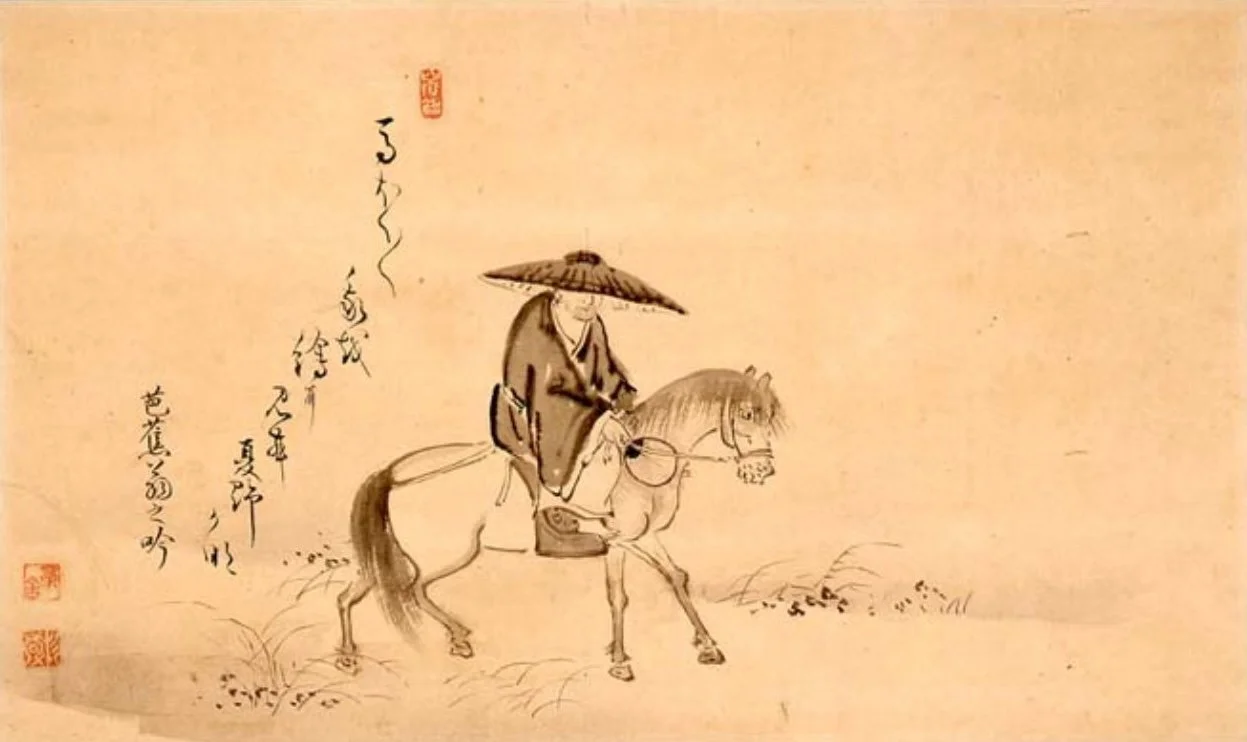
Matsuo Basho riding a horse by Sugiyama — public domain (Government of Japan).
Every day a journey, and the journey itself is home.
日々旅にして 旅を栖とす
— Matsuo Bashō, The Narrow Road to the Deep North (1689)
W e often show up already prepared. In the past, a journey could change how we think, but now it usually just confirms what the guidebook or the internet has already told us.
There is an older, simpler tradition that stands apart from today’s carefully planned approach. I first heard the phrase “wandering scholarship” in an interview with writer Michael Ondaatje, where he talked about Bashō, the seventeenth-century wandering poet.
As a traveller and a student of Zen, the journey represented to Bashō all the mystery there was in the universe. Bashō travelled not simply to gather knowledge but to cultivate a quality of looking. Attention, for him, was the discipline. The road was where he went to practice it.
In Basho’s universe, there was no such thing as “travel writing” as we know it. Western writing at the time was concerned with navigation, trade, empire. The catalogue of distant places. Even within Japanese literature itself the travel diary was often quite mannered, and the writer would pass from one famous poetic place name or utamakura to the next, paying tribute within the conventions of classical court poetry.
Basho converted his restless wanderings into a philosophy: “Learn of the pine from the pine, and of the bamboo from the bamboo.” He fully absorbed his surroundings as he journeyed. In the afternoon, he would socialize, exchange ideas, and write his three-line haiku with friends and disciples he met along the road.
The form he used, haibun, alternated poem and prose, but they stood side by side, rather than the poem folding into the prose or the prose folding into the poem.
There was no explanation. It was a format I loved.
閑さや
岩にしみ入る
蝉の声Such stillness
Piercing into the rock,
The cry of the cicada.
Bashō was, in a deep sense, an egalitarian in his attention. He did not distinguish between the grand and the petty. The stillness of the ancient, moss-covered temple at Yamadera and the sound of a frog plopping into an old pond both merited a haiku.
He found grace in a bowl of rice where another might see merely ordinariness, because anything could feel special if attended to.
This comes very close to what the Japanese call ‘mono no aware’, the poignancy of things, and the recognition that the moment’s beauty is partly in the fact of its passing. Both a great temple and an insect or a frog in a pond are in this way disappearing. His attention did not discriminate; it merely met it.
古池や
蛙飛び込む
水の音The old pond
a frog jumps in,
sound of water.
That did not last long. In the West, the Grand Tour, although in theory concerned with education, mutated from a broad circuit of Europe to a constricted round of Rome, Florence, Venice. The undemanding gaze became the demanding one.
The arrival of the guidebook began to dictate to the traveler what was worth seeing, in what order.
The package tour further refined this, stipulating not just what was worth seeing but how long you were allowed to see it. The Internet to-do list is merely the most recent, hyper-efficient manifestation of this trend. Travel ceased to be an occasion for study, an opportunity for attention, and instead became an event or a backdrop-something to be “ticked off” or “claimed.” First in travel photographs and later on social-media.
None of this implies that travel today is pointless. It is just, I believe, different from what it used to be. The price is that our attention has atrophied to such an extent that we rarely give equal weight to a frog and a temple.
We come armed with information and already sorting: worthy, unworthy, photographic, not photographic, on the list, off the list.
Place becomes what is to be seen, and that seeing gets in the way of paying attention. As Rebecca Solnit has written, walking can serve to bring the mind, the body and the world into harmony; in the same way, the attention Basho cultivated could not be rushed, categorized, or accumulated-it could simply be given.
We don’t have to sell all our possessions or wander for two years like Basho to become “wandering scholars.” We only need to change our pace and our intention. It is that simple: the noise falls away as we practice attention.
When travel is conceived of in this way, no individual trip is ever a complete, self-contained story; instead, it’s the continuation of an ongoing quest.
Over years and decades, across cities, landscapes, and encounters, we carry a sense of discovery about ourselves, tied to the memories of the road. One trip isn’t enough on its own, but it contributes to an ongoing education. What matters then, is not, “where did you go?” but, “what did you discover and what does it tell you about what came before?”
Basho himself wrote, “I do not seek to follow in the footsteps of the men of old, I seek what they sought.” To travel as Basho traveled is to cultivate the quality of attention that lent value to his journeys. We need to delight not just in the destination, but in the passage.
This invitation is open to all of us-no matter our age, budget, or origin.
Let’s not just see the world, let’s attend to it. Reclaiming travel doesn’t necessarily mean avoiding tourist spots or heading to remote locations; it means recovering our capacity for wonder.
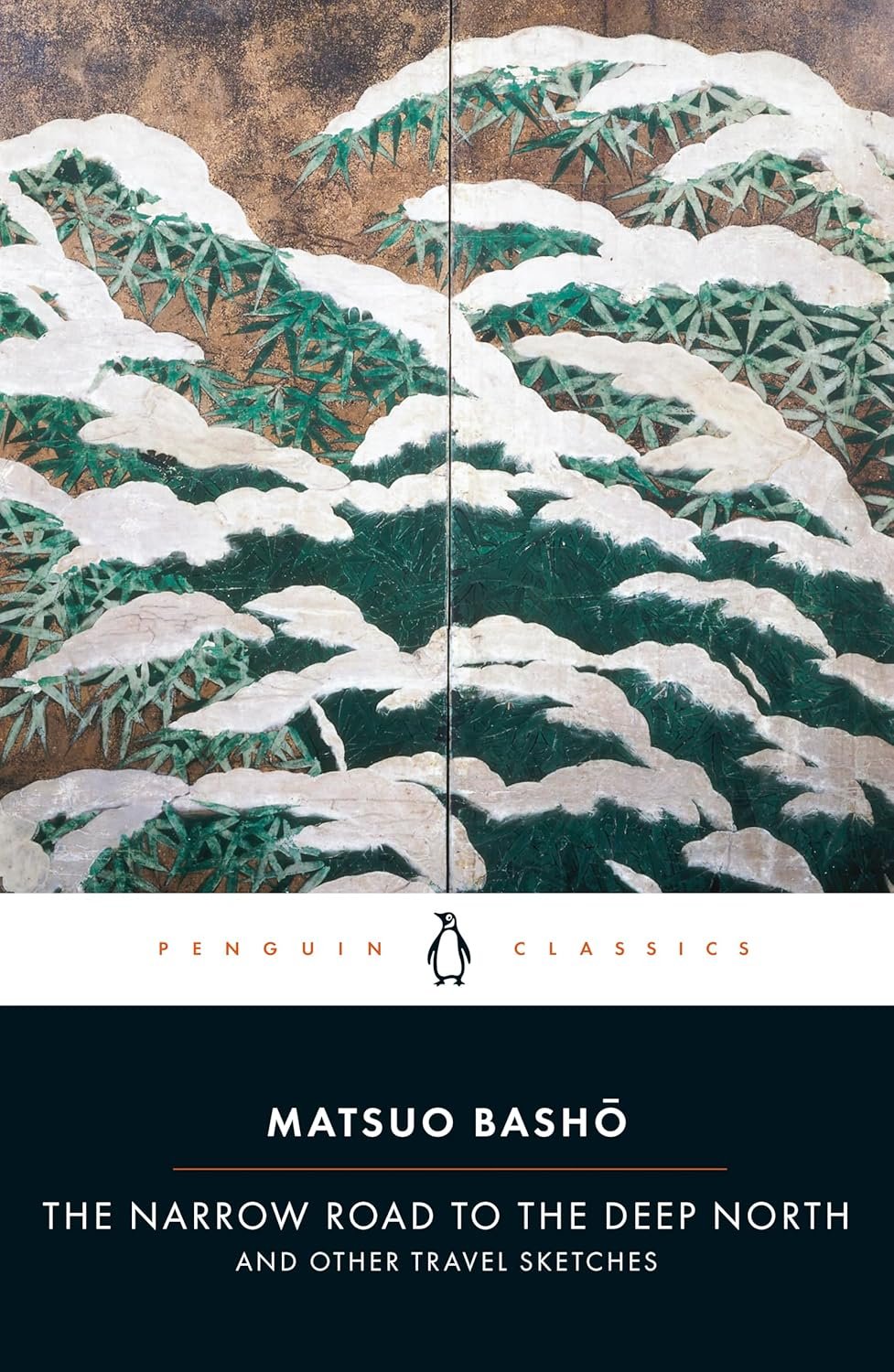
Matsuo Basho
I loved the title of this book long before I read it. I assumed it to be some lengthly saga of ‘travels of old’, but it’s quite the opposite. In this slim volume of travel sketches Bashō writes of the seasons changing, the smell of the rain and the brightness of the moon through which he sensed the mysteries of the universe. The Christian mystic Thomas Merton went into raptures over it. A little Zen knowledge helps, but it’s gift to any curious traveller.