Waking Up in the Khumbu Valley
On failing to make the summit — and what I found instead
1.
I sat at a table for one, watching a Sherpa carry my breakfast to me on a tray. He walked slowly across the moraine, trying not to spill my coffee. The wait was awkward and colonial. I realised that I didn’t even know his name.
Should I have gone over and taken the tray from him? In the nausea of altitude sickness, it didn’t seem a good idea. Base camp was empty. My teammates were high above me, climbing the ice wall on Island Peak, a 6,200-metre mountain in the shadow of Everest.
I had signed up with a British expedition company, and in just three weeks of holiday from work, I was set to climb my first Himalayan peak.
Beyond Namche Bazaar, I felt nauseous and the headaches began. The Dal Bhat at the teahouses turned from comfort to trial. I wanted a day’s rest to acclimatise, but the schedule was too tight. We only had one spare day, and it was reserved for emergencies. I had always been strong in the mountains, but my experience in the Alps seemed to count for little here.
The group, mostly British climbers, coped better than I did. Conversation revolved around work, previous adventures, current fitness. I was physically in Nepal but mentally I’d not left Britain.
Just after Dingboche, we left the Everest Base Camp trail and climbed Pokalde, a 5,806-metre trekking peak, in time for a dawn cloud inversion over the whole Khumbu Valley. It was the sort of view mountaineers treasure. I witnessed it, and threw up on the climb to summit.
I told myself I felt sick because I was the only person in the group not taking Diamox. I told myself altitude sickness was a lottery. I told myself that even famous climbers had suffered from altitude sickness in the Himalayas. I told myself I would feel better soon. None of it helped.
The evening before the summit bid, I could not walk in a straight line to the toilet tent. Fearing something worse, I pulled out of the expedition. My English guide was disappointed. In the way a father might say he was ‘disappointed’.
I’d fallen off a conveyor belt that was moving too fast.
My tent mate left at 2 a.m., and I wished him luck. Later, I learned he collapsed on the summit and had to be lowered down the fixed ropes on the mountain.
2.
I packed up my gear as the Sherpas ate breakfast in a huddle. I told them I was walking down to Dingboche to lose some altitude. Pema filled up my water bottles and said he would walk with me.
Until then, Nepal had been mediated through the expedition. Walking down with Pema, that arrangement fell away.
We walked in silence until he asked me “do you have a religion?”. I told him no, but I had started to meditate with a local Zen group. Pema told me he followed Tibetan Buddhism, which worships a litany of old animist mountain gods and Buddhist deities. In the imposing valley where we were dwarfed by foreboding 8,000-metre peaks, one could sense that something other than humans are in charge here. Mountain gods seemed appropriate. I could see why Pema had no truck with Zen.
I flopped on a rock and gazed at the glinting pyramid of Ama Dablam. A mountain often called ‘the Matterhorn of the Himalayas’ in European expedition brochures. I had studied diagrams of the routes. I knew the position of the high camps. I knew where the crux of the route was, and I knew that it was a four-week holiday.
I realised that our expedition had not begun with the traditional Puja, a ceremony that takes place to bless the ropes and ice axes, and ask the mountain for safe passage. We had flown in, organised our kit, and marched into this land of old gods. Pema shrugged and said “yes, it’s common, but it’s disrespectful and unlucky”.
I might have pondered how western enlightenment thinking, with its empirical reason and the mastery of nature, clashes with traditional Tibetan view of the land as living and sacred.
But all I wanted was lunch.
3.
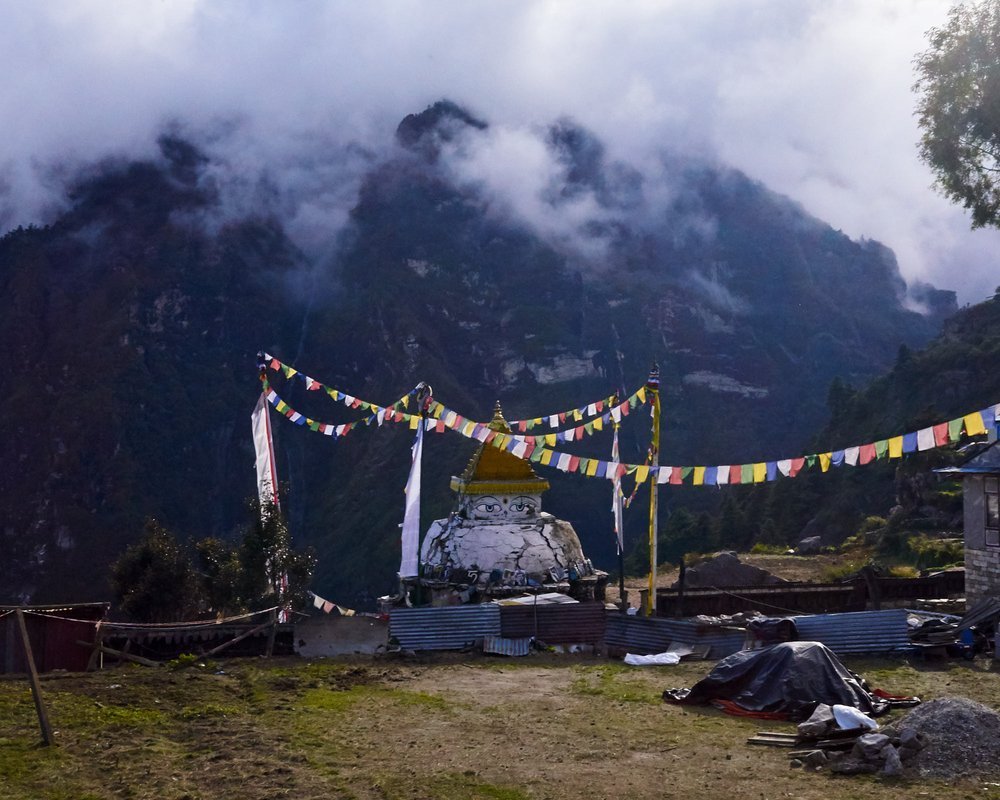
Ten years on, while the others in the group have summit photos, I treasure an image of an eye painted on a stupa above Namche Bazaar. A compassionate eye watching over us all.
The story I expected to tell ended on an ordinary morning, when a Sherpa, whose name I still don’t know, walked across the moraine to bring me my morning coffee. At the time, all I could think about was my altitude sickness, my failure to summit, and what others might think.
On the walk down to Dingboche, I had the first conversation that wasn't about climbing, with someone from a different culture, with a different perspective from my own. I was travelling without achievement and with every step I felt unfettered.
I think of that journey as a kind of ego death, but at the time I just wanted to know when we’d stop for tea and Dal Bhat.
On expeditions these days, I’m in the huddle - making coffee with my hosts instead of waiting for it to be carried to me. Physically there. Actually there.