Werner Herzog, Bruce Chatwin, and the sacredness of walking
In the early 1980s, in Melbourne, film maker Werner Herzog arranged to meet the celebrated writer Bruce Chatwin, was in Australia researching a new book, The Songlines. Over the phone, Chatwin explained how to spot him: "I'm tall and blond. I look like a schoolboy, and I wear a leather rucksack.”
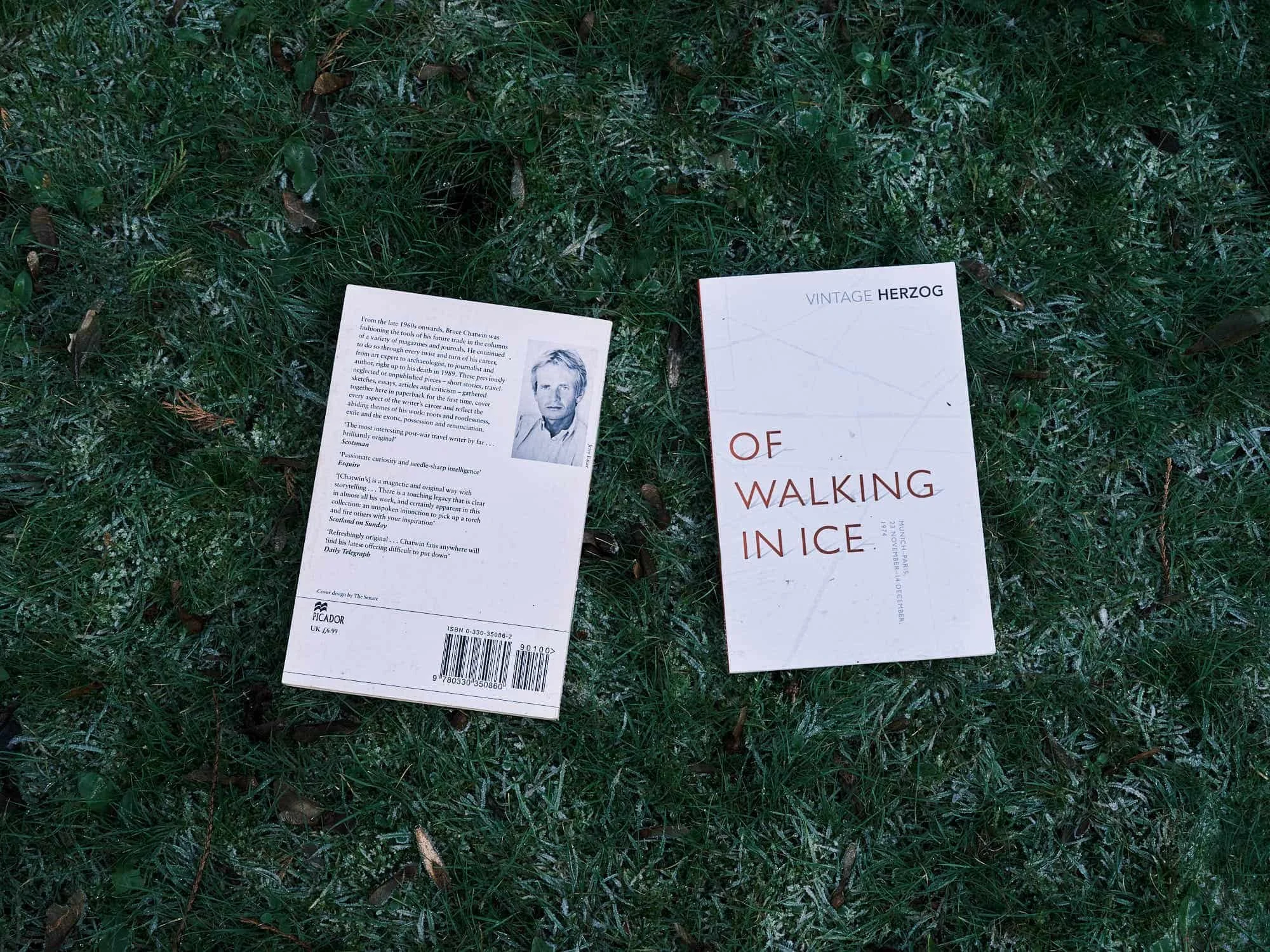
They met at Melbourne airport—Herzog picked Chatwin up as he was returning from central Australia toward England—and then spent roughly 48 hours telling each other stories, with little sleep. Herzog admired In Patagonia and The Viceroy of Oudidah, and was surprised to find Chatwin carrying Herzog’s own book, Of Walking in Ice, in his rucksack.
Of Walking in Ice tells the story of how Hertzog walks 300 miles from Munich to Paris in depths of winter because he believes his mentor Lotte Eisner will not die if he arrives on foot.
in the irrational, fiercely held conviction that arriving on foot would keep her alive.
Of Walking in Ice tells the story of how, Hertzog once walked thousands of kilometres in the depths of winter from Munich to Paris. After he received word that his mentor, film historian Lotte Eisner, was on her deathbed in Paris. Refusing to accept it, he packed bare essentials, a compass, and a notebook, laced up a new pair of boots in Munich, and set off on foot—roughly five hundred miles—in the irrational, fiercely held conviction that arriving on foot would keep her alive.
Hertog coined the dictum “the world reveals itself to those who travel on foot.” which expressed his belief in the magical power of walking. Naturally, Chatwin approved. Writing In What Am I Doing Here, Chatwin wrote that Herzog was: “the one person with whom I could have a one-to-one conversation, on what I would call ‘the sacramental aspect of walking.’” and that “He and I share a belief that walking is not simply therapeutic for oneself but is a poetic activity that can cure the world of its ills.”
Chatwin and Herzog also shared a dislike of the 'accountants truth'. A phone book was full of facts, he liked to say, and it illuminated nothing. Both men understood that the world does not reveal itself to the scrupulous stenographer. It yields only to those willing to stage it. s built on a shared philosophy: that travel is not about tourism or sightseeing, but a profound, almost sacred act of walking, deep curiosity, and creative myth-making
Which to me, is what makes their books so marvellously readable. Both see he world in a kind of ecsttaic truth.
Herzog argues that raw facts alone do not illuminate the human condition, famously noting that the Manhattan phone directory has four million factually correct entries yet reveals nothing about life
While Chatwin cultivated a myth of traveling light with just his signature leather rucksack, he also carried books, notes, and other personal belongings—and famously gifted that same rucksack to Herzog before his death
Neither Chatwin nor Herzog cared for the 'accountants truth'Chatwin was a master of blurring the lines between journalism, memoir, and fiction—modifying details so that his stories captured a deeper emotional or mythic truth rather than a dry record of events, a technique mirrored in Herzog’s cinematic style
Chatwin and Hertzog also shared a love hated psychological interiority and vague philosophizing. His prose stays electric because it is obsessed with things: a silver mate cup, a cracked porcelain shard, the exact weight of a Moleskine notebook, the pale blue eyes of an exiled Welshman. Herzog works the exact same way—he doesn't talk about "the human struggle against nature"; he drags a three-hundred-ton steamship up a hill in Peru, or walks from Munich to Paris in winter because he believes his mentor Lotte Eisner will not die if he arrives on foot[3].
Herzog had no patience for what he called the accountant’s truth; a phone book was full of facts, he liked to say, and it illuminated nothing. Both men understood that the world does not reveal itself to the scrupulous stenographer. It yields only to those willing to stage it.
Chatwin never forgave a fact for getting in the way of a rhythm. Long before Patagonia, while working as a Sotheby’s auctioneer in his twenties, he learned the intoxicating value of provenance—how a splinter of wood or a scrap of fur becomes priceless the moment someone attaches a compelling lie to it. When he met Herzog, he found a man running the exact same confidence game, only with thirty-five-millimeter film instead of adjectives. Herzog had no patience for what he called the accountant’s truth; a phone book was full of facts, he liked to say, and it illuminated nothing. Both men understood that the world does not reveal itself to the scrupulous stenographer. It yields only to those willing to stage it.
Chatwin altered facts so that they might resemble truth. Herzog called this ecstatic truth. The question is not whether the phrase excuses the lie, but what kind of truth survives the alteration.
To me, Chatwin and Herzog embody Because that little book proved something Chatwin believed to his core: great travel has never really been about geography.
Bruce Chatwin and Werner Herzog shared a profound artistic kinship built on what Herzog famously termed "ecstatic truth"—a deeper, poetic reality reached through imagination, stylisation, and storytelling rather than strict literal facts
Blurring Fact and Fiction. Chatwin was notorious for embellishing his travel writing—such as In Patagonia and The Songlines—blending journalism, myth, and invention to capture the spiritual essence of a place rather than a dry literal record. [1, 2]
Kindred Storytelling. Herzog admired Chatwin as a compulsive, mesmerizing storyteller who altered details to heighten the emotional and existential impact of his tales. [1]
The "Internet Before the Internet". Herzog viewed Chatwin as a living network of obscure knowledge, connecting distant cultures, texts, and mysteries across the globe through his restless curiosity
Rejection of "Accountant's Truth". Herzog argues that raw facts alone do not illuminate the human condition, famously noting that the Manhattan phone directory has four million factually correct entries yet reveals nothing about life
Both are contemporary storytellers with a poetic grasp of the numinous intensity of physical reality and a propensity to balance their narrative art forms on the knife edge of fact and fiction.
There was nothing exotic about the route. Herzog wasn't hacking through unmapped jungle; he was trudging across paved roads, frozen farmland, and quiet French villages in late-autumn rain and snow, sheltering in barns and empty houses while passenger jets roared overhead that could have carried him there in ninety minutes. Yet private urgency turned an ordinary stretch of Western Europe into a pilgrimage. When he reached Paris three weeks later, Eisner was still alive; she lived for another nine years.
fellow itinerant Werner Herzog to embark on a journey that Chatwin — an extraordinary man whom Herzog calls “kindred spirit” — would regularly undertake. Those familiar with works of the German cineaste know that he has always been an avid explorer of mysterious, remote locales and forgotten cultures; through his reliably curious camera, and with a shared existential and ontological approach, Herzog has always sought to capture mankind’s obsession with and bewilderment at the feet of vast, untamed landscapes, evinced both in his early fiction works and in his more recent documentary features. It’s this broad, consuming fascination with history, archeology, anthropology, mythology, and the natural that bonded Herzog and Chatwin, a
Bruce Chatwin and Werner Herzog shared a profound artistic kinship built on what Herzog famously termed "ecstatic truth"—a deeper, poetic reality reached through imagination, stylisation, and storytelling rather than strict literal facts
Rejection of "Accountant's Truth". Herzog argues that raw facts alone do not illuminate the human condition, famously noting that the Manhattan phone directory has four million factually correct entries yet reveals nothing about life
Both are contemporary storytellers with a poetic grasp of the numinous intensity of physical reality and a propensity to balance their narrative art forms on the knife edge of fact and fiction. hen we watch Herzog in interview or read his famous Minnesota Declaration, it’s hard for us not to be reminded of Bruce Chatwin and the way he repeatedly flouts the empirical basis of non-fiction prose with his constant impulse towards fabulation. As Herzog states in his Minnesota Declaration, “There are deeper strata of truth in cinema, and there is such a thing as poetic, ecstatic truth. It is mysterious and elusive and can be reached only through fabrication and imagination and stylisation.”
egnsvad analyzes key moments in a range of Herzog’s films, from the earliest in the late 1960s to the most recent releases, to shed light on Herzog’s relentless search for moments of “ecstatic truth” in film.
“He would craft mythical tales into voyages of the mind. In this respect, we found out we were kindred spirits. He as a writer, I as a filmmaker. In this film, I will follow a similar erratic quest for wild characters, strange dreamers, and big ideas about the nature of human existence. These were the themes Chatwin was obsessed with.”
At several points in their lives, the two men’s lives had intersected, and there were landscapes that they’d explored independently and unaware of each other, sometimes with years in between. The shipwreck in Punta Arenas was one such point. Yet rather than being biographical or tracing out all the travel book’s wild stories, Herzog’s film follows just a few of them that echo his own interests.
And, in a line Herzog says Chatwin especially loved:
“Walking is virtue, tourism deadly sin.”
To Chatwin—reading those pages as a stranger years later—the journey meant something because it stripped travel down to pure imagination. You didn't need an uncharted frontier to make a landscape electric; you only needed a reason to walk through it with your eyes wide open. Both men shared a fierce disdain for passive sightseeing, summed up in Herzog's maxim: "Tourism is sin, and travel on foot virtue." As he later put it, "The world reveals itself to those who travel on foot."Shortly before his death in 1989, Chatwin bequeathed that leather rucksack to Herzog—"You are the one who should carry it"—and Herzog still travels with it today, keeping a tiny notebook and pen inside.
We often talk as though wonder vanished the moment satellites mapped the last coastlines and tourists crowded every landmark. That book in Chatwin's rucksack suggests otherwise. A place is only exhausted if your curiosity is. Even in a thoroughly charted world, imagination remains an open frontier—and often, all it takes to cross it is the right book in your bag, giving you an unexpected reason to set out and see familiar ground as if for the first time.
Why would a writer drawn to the remotest corners of the earth carry a German filmmaker's short European diary into the interior of Australia? Because that little book proved something Chatwin believed to his core: great travel has never really been about geography.There was nothing exotic about the route. Herzog wasn't hacking through unmapped jungle; he was trudging across paved roads, frozen farmland, and quiet French villages in late-autumn rain and snow, sheltering in barns and empty houses while passenger jets roared overhead that could have carried him there in ninety minutes. Yet private urgency turned an ordinary stretch of Western Europe into a pilgrimage. When he reached Paris three weeks later, Eisner was still alive; she lived for another nine years.
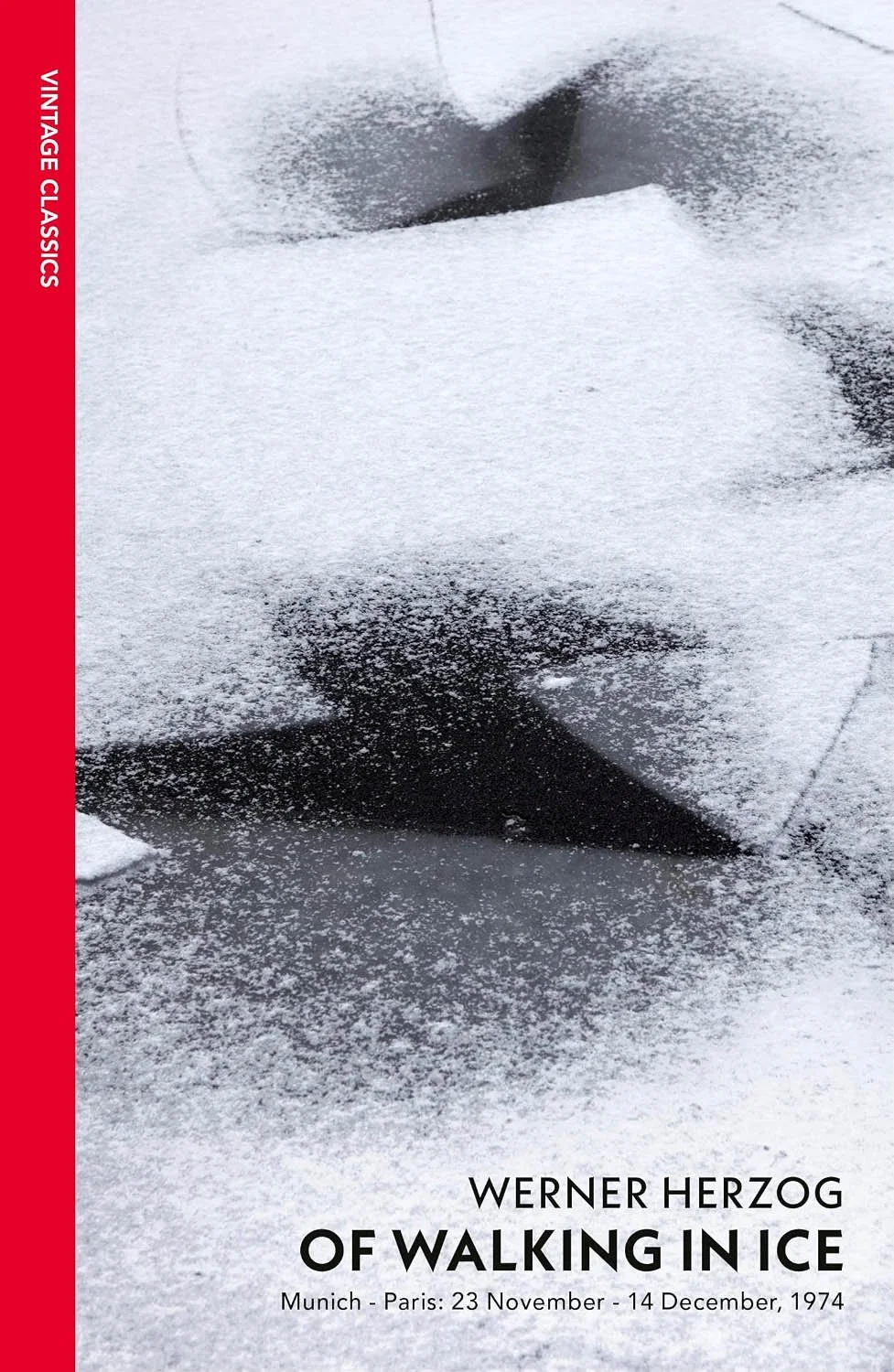
Of walking in Ice
Werner Herzog
A slender book (my favourite kind) as rich as any of Herzog’s films. In November 1974, upon learning that his friend, film historian Lotte Eisner, was gravely ill in Paris, Herzog set off to walk an icy 500 miles in full faith that she would stay alive if he came on foot. Of Walking in Ice is about the (absurdist?) belief that a physical act of endurance can alter destiny. Pure Herzog: in print.