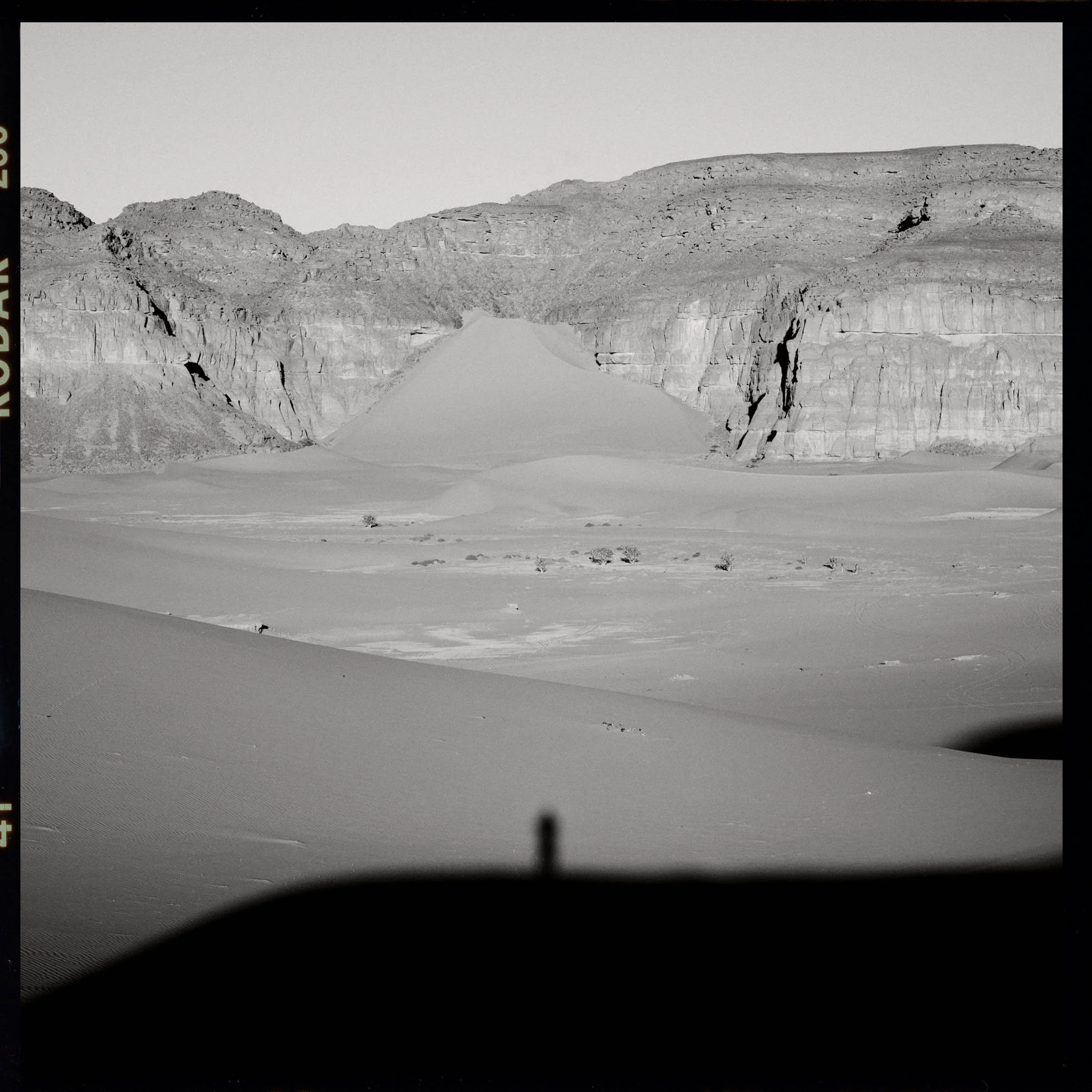
Baptism of Solitude
A Thirty Year Wait for the Silence of the Sahara
LED BY A BOOK
Their Heads Are Green and Their Hands Are Blue - Paul Bowles
In 2022, I travelled to the Algerian Sahara, compelled to experience the absolute silence of the Sahara Desert that Paul Bowles wrote about in his essay ‘The Baptism of Solitude’, in 1956.
Ifound Their Heads Are Green and Their Hands Are Blue in a mobile library van in rural Shropshire. I was fourteen. I’m not sure why it appealed to me — perhaps the pickings were slim that day — but a short essay in the book called ‘The Baptism of Solitude’, lodged itself in my imagination.
Paul Bowles was an American writer who lived in Tangier in the 1950s. He wrote lean, unsettling fiction about Westerners coming undone in North Africa. He was fascinated by the desert’s pull on outsiders. What Bowles prized most was not the landscape itself, but its solitude: the sensation of existing in the middle of something absolute. In The Baptism of Solitude, he describes the experience of encountering the the ‘vast, luminous, silent country’ of the Sahara for the first time.
“Presently, you will either shiver and hurry back… or you will go on standing there and let something very peculiar happen… you have the choice of fighting against it, and insisting on remaining the person you have always been, or letting it take its course”
— Paul Bowles, Baptism of Solitude
I carried these words with me for thirty years. Now I wanted to know what they might mean beyond the page.
One evening, in the Tassili n'Ajjer, I left the group at the camp and walked out into the desert. We had all been doing this for toilet breaks during the trip, but this time I walked further, until the comforting sounds of conversation around the campfire disappeared.
I stood on a rise and looked at the strange geography around me. There was no wind, no trees, no insects, no animal noises. The only sound was me: the movement of my feet in the sand, my breath. The complete absence of noise was something I could physically feel, like a pressure against the skin.
At first, my modern mind resisted it. I was on holiday, enjoying the companionship of my Polish travelling companions, the spectacular scenery, the music of our Tuareg guides.
But Paul Bowles was at my shoulder: you either hurry back to the safety of the fire, or you stay and let something happen.
I realised then how much of our lives we spend generating noise simply to avoid this very state; our constant talk and relentless distraction are often just defences against the sacred terror of an encounter with the absolute. In ordinary life, we are protected by routine, social conventions, and ambient clutter. Out here, those protections vanished.
I decided to stay. I closed my eyes, shivered, and gave in to the ancient stillness around me. For a few moments the silence overwhelmed, my internal chatter was replaced by a strange sensation of dread and deep peace.
The whole episode lasted perhaps five minutes. It remains, without question, the most profound toilet break I will ever take.
After it was over, I walked back to the warmth of the campfire, Tahir, one of our Tuareg crew, looked across the fire at me.
“Did you feel the silence?” he asked.
I don’t know whether Tahir would care for the ideas of an American existentialist writer from the 1950s – but all three of us might agree that there is something simultaneously frightening, calming, and profound in the Sahara Desert.
As Bowles wrote: “For no one who has stayed in the Sahara for a while is quite the same as when he came.”